
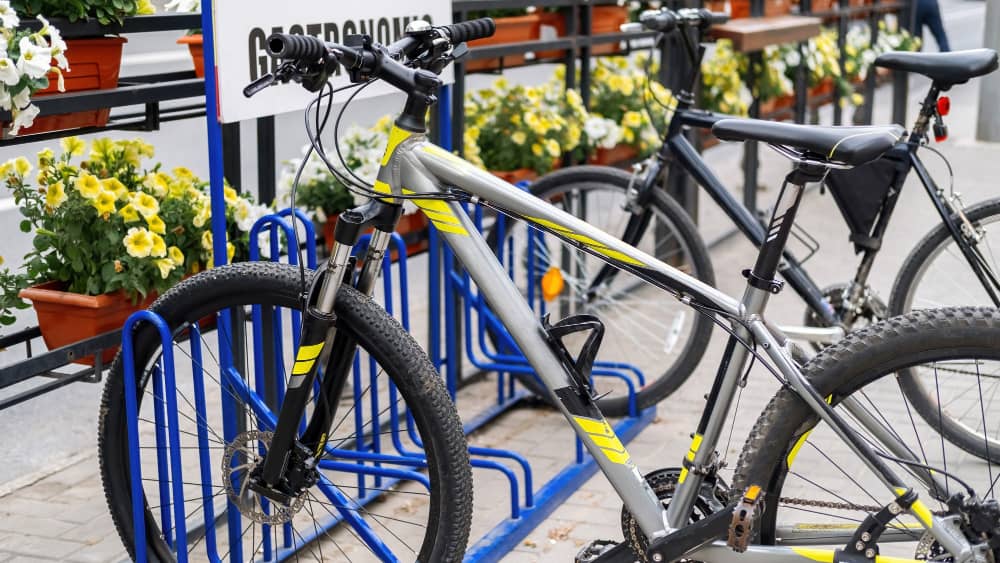
Bicycle parking is no longer simply an addition to street furniture . For a municipality, it represents a lever for land-use planning, ecological transition, and the attractiveness of the city center.
Inadequate public bicycle parking creates congestion, illegal parking, and dissatisfaction. Conversely, a well-designed system truly supports active mobility.
DGS, technical services, elected officials in charge of mobility or urban planning: the sizing must be based on a detailed analysis of the actual uses of the inhabitants.
1. Understanding local flows and practices
Table of contents
ToggleThe starting point remains observation.
Identify areas of high demand
Bicycle parking facilities are not sized solely based on the total population. They must take into account:
- the areas surrounding shops,
- educational establishments,
- multimodal stations and hubs,
- sports and cultural facilities,
- administrative buildings.
A saturated parking space in front of a school at 8:30 a.m. and 16:30 p.m. indicates a specific need, different from a tertiary area that is continuously frequented.
Analyze parking duration
The average occupancy duration influences the type of solution:
- Short-term parking in the city center → accessible and visible parking barriers
- long-term parking near a train station → shelter Secure outdoor bicycle storage or lockers
The same neighborhood may require several different types of housing.
2. Adapt the offer to the new formats
The park is evolving rapidly.
Electrically assisted bicycles
The VAE are heavier and more expensive.
They demand:
- sturdy supports,
- possibility of attaching the frame,
- sometimes a charging point framed.
A municipal bicycle parking facility that ignores this development quickly becomes inadequate.
Cargo and family bikes
Families are increasingly using longtail bikes or cargo bikes.
These models require:
- greater depth,
- enhanced stability
- a specific parking area.
Not providing cargo bike parking leads to cross parking and inconveniences other users.
Scooters and light electric vehicles
In some municipalities, electric scooters represent a significant portion of short journeys.
An organized space avoids congestion on sidewalks and at building entrances.
3. Size according to the expected progression
The sizing cannot be limited to the current situation.
A municipality committed to a cycling plan or a cycling master plan must anticipate:
- the increase in the number of cyclists,
- the evolution of school habits,
- urban densification,
- the development of new neighborhoods.
An undersized community bicycle parking facility quickly leads to visible saturation.
The analysis must include a three- or five-year projection.
4. Safety and visibility: two key criteria
Theft protection
The level of security depends on the context:
- dense city center,
- Residential area,
- proximity to a train station.
In exposed areas, closed or controlled solutions may be necessary.
A parking area perceived as unsafe remains underutilized.
Visibility and accessibility
A hidden archway behind a building will rarely be used.
Parking must be:
- visible from public spaces,
- accessible without obstacles,
- positioned in line with pedestrian traffic.
Ergonomics directly influences the usage rate.
5. Integrate parking into urban planning
Bicycle parking should not be considered in isolation from a broader perspective.
Technical services must ensure that:
- preserve the width of the sidewalks,
- to avoid conflicts with people with reduced mobility,
- to maintain the legibility of public spaces,
- to comply with urban planning and road regulations.
A coherent approach improves the overall perception of mobility policy.
6. Budgetary trade-offs and sustainability
The choice of equipment cannot be guided solely by unit cost.
A fragile or unsuitable support leads to:
- rapid deterioration
- increased maintenance
- premature replacement
- negative image for the community.
Investing in robust equipment adapted to the actual flow ensures greater sustainability.
The municipal bicycle parking facility should be considered as a structuring element of the public space.
Bicycle parking: moving from quantity to relevance
Designing bicycle parking for a municipality is not simply about adding more bike racks. It's about meeting the actual needs of residents, anticipating how those needs will evolve, and integrating parking into a comprehensive urban planning strategy.
A suitable, secure and well-established system strengthens the credibility of local cycling policy and sustainably supports active mobility.